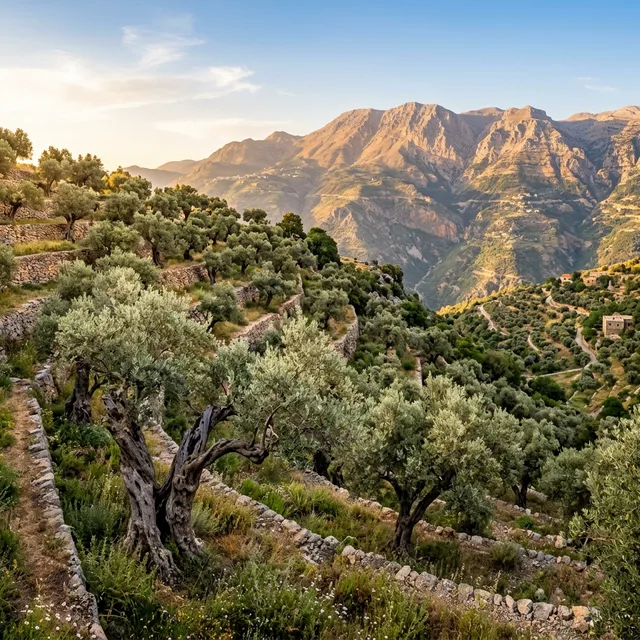
Lebanese olive oil comes from one of the oldest olive-growing civilizations on earth. Lebanon has over 60 million olive trees — some confirmed at 2,000+ years old — planted across terraced mountain slopes, coastal plains, and the Beqaa Valley. Lebanese olive oil production predates the Roman Empire. The Phoenicians, Lebanon's ancient seafaring ancestors, were among the first to trade olive oil across the Mediterranean. Today, Lebanese olive oil remains a hidden gem — underappreciated internationally despite exceptional quality from native varieties that exist nowhere else.
Lebanese Olive Oil: Why It's Unique
Lebanese olive oil stands apart from its Mediterranean neighbors for several reasons.
Native varieties: Lebanon cultivates olive varieties found almost nowhere else in the world. While Italy relies on Coratina, Greece on Koroneiki, and Spain on Picual, Lebanese olive oil is built on indigenous cultivars — Soury, Ayrouny, Baladi, and Khoudairy — that evolved over millennia in Lebanon's specific terroir. These varieties produce distinctly Lebanese flavor profiles impossible to replicate elsewhere.
Altitude diversity: Lebanon packs extraordinary geographic diversity into a tiny country (10,452 km²). Olive groves grow from sea level along the coast to 800+ meters in the mountains. This altitude range creates radical variations in Lebanese olive oil character — coastal oils are milder and fruitier, mountain oils are more intense and polyphenol-rich.
Ancient trees: Lebanon's millennial olive trees — particularly in Bchaaleh, Batroun, and the Chouf — produce oil with a complexity that young groves can't match. Root systems reaching deep into limestone bedrock extract minerals that contribute to distinctive terroir. Lebanese olive oil from ancient trees is a taste of living history.
Traditional production: Many Lebanese olive oil producers still use stone mills — some powered by water, others by donkeys — alongside modern facilities. This isn't backwardness; it's deliberate preservation of cold-press traditions that extract oil at lower temperatures, preserving volatile aromatics lost in high-speed industrial extraction.
Lebanese Olive Oil Varieties
Soury (Souri)
The dominant variety in Lebanese olive oil production. Soury olives originated in the region of Tyre (Sour) in southern Lebanon — hence the name. This variety produces oil with moderate-to-high bitterness, strong peppery pungency, green herbaceous notes, and excellent polyphenol content (400-700mg/kg in early harvest). Soury is Lebanon's equivalent of Italy's Coratina — robust, health-forward, and unapologetically intense.
Ayrouny (Ayrouni)
A softer, more delicate variety grown primarily in northern Lebanon. Ayrouny produces Lebanese olive oil with gentle fruitiness, low bitterness, buttery texture, and almond-apple flavor notes. Polyphenol content is moderate (200-400mg/kg). This is the variety for people who find Soury too aggressive. Ayrouny Lebanese olive oil works beautifully as a finishing oil for fish, white beans, and fresh salads.
Baladi
"Baladi" means "local" in Arabic — it's the catch-all term for unnamed heritage varieties grown from seed rather than grafted rootstock. These trees are genetically unique — every Baladi tree is different. Lebanese olive oil from Baladi trees is unpredictable and exciting. Each village's Baladi oil tastes distinct, reflecting hyperlocal terroir. This genetic diversity is irreplaceable and increasingly threatened by modernization.
Khoudairy
A dual-purpose variety used for both table olives and oil. Khoudairy olives are large, fleshy, and produce Lebanese olive oil with mild, round flavor — moderate fruitiness, minimal bitterness, and a clean finish. Lower polyphenol content than Soury but higher oil yield per olive, making it commercially efficient for Lebanese olive oil producers focused on volume.
Lebanese Olive Oil: Key Regions
Northern Lebanon (Koura, Zgharta, Batroun)
The Koura district in northern Lebanon is Lebanon's olive oil capital. Over 360,000 olive trees carpet the hillsides between Tripoli and the Qadisha Valley. Lebanese olive oil from Koura is predominantly Soury — intense, green, and high in polyphenols. The FAO has recognized Koura's olive oil heritage as internationally significant.
Batroun adds another dimension. The coastal town's ancient groves host some of Lebanon's oldest trees — several confirmed at 1,500-2,000 years old by the American University of Beirut. Lebanese olive oil from these millennial trees is limited in quantity but extraordinary in character — complex, mineral-forward, with a finish that lingers for minutes.
South Lebanon (Hasbaya, Marjayoun, Nabatieh)
The Hasbaya district produces some of the finest Lebanese olive oil in the country. The microclimate — influenced by Mount Hermon's snowmelt, volcanic soil, and warm southern exposure — creates optimal conditions for early-ripening, high-polyphenol Soury olives. Hasbaya Lebanese olive oil has won multiple medals at the NYIOOC World Olive Oil Competition.
Mount Lebanon (Chouf, Metn)
The Chouf mountains — home to the famous Chouf Cedar Reserve — also host significant olive groves at 500-800m altitude. Lebanese olive oil from the Chouf is mountain oil — slow-ripening, concentrated, and intensely aromatic. The Druze communities of the Chouf have maintained olive cultivation as a cultural cornerstone for centuries.
Beqaa Valley
Lebanon's fertile inland valley is primarily known for wine (Chateau Musar, Ksara) but also produces Lebanese olive oil from younger groves planted in the last 50 years. Beqaa olive oil is typically milder than northern or southern Lebanese olive oil — reflecting the valley's warmer temperatures and irrigated growing conditions.
Top Lebanese Olive Oil Producers
- Darmmess (Hasbaya): Premium single-variety Soury Lebanese olive oil from 600-year-old trees. Early harvest, cold-pressed within 4 hours of picking. NYIOOC gold medal winner. Published polyphenol data. $25-40 per 500ml. The benchmark for modern Lebanese olive oil.
- Oleavanti (Koura): Organic Soury and Ayrouny blends. Modern extraction facility with traditional grove management. Clean, well-documented production. $20-35 per 500ml.
- Bustan El Zeitoun (Batroun): Small-batch Lebanese olive oil from ancient trees. Limited production — under 5,000 bottles per year. Sold primarily through farmers' markets in Beirut and direct export. $30-50 per 500ml.
- Zejd (multiple regions): Social enterprise producing Lebanese olive oil from cooperative groves across Lebanon. Fair-trade certified, organic, and beautifully packaged. Available internationally through specialty importers. $22-35 per 500ml.
- The Lebanese Olive Oil (LOO): Export-focused brand producing consistent, mid-premium Lebanese olive oil for the diaspora market. Available in Lebanese grocery stores worldwide. $15-25 per 500ml. Good everyday Lebanese olive oil.
Lebanese Olive Oil Tasting Profile
Lebanese olive oil — particularly Soury-based — has a distinctive character that experienced tasters can identify blind.
- Aroma: Green herbs (wild thyme, zaatar), fresh artichoke, green tomato, with a distinctive mineral undertone that reflects Lebanon's limestone geology
- Taste: Medium-to-high bitterness, green almond, chicory, and a savory complexity that differentiates Lebanese olive oil from single-note oils
- Finish: Pronounced pepper burn (oleocanthal), longer than most Greek oils, with a persistent warmth that pairs naturally with bold Lebanese cuisine
- Texture: Medium-bodied, slightly viscous, with a clean mouthfeel that avoids the heaviness of some Puglia oils
Lebanese Olive Oil in Lebanese Cuisine
Lebanese olive oil isn't just an ingredient — it's a foundational element of one of the world's great cuisines.
Hummus: Real Lebanese hummus finishes with a generous pool of raw EVOO. The olive oil doesn't just add fat — it provides peppery counterpoint to the tahini's sweetness. Lebanese olive oil's Soury bitterness cuts through the richness perfectly.
Fattoush: This Lebanese salad uses olive oil as a dressing rather than vinaigrette. Raw Lebanese olive oil, lemon juice, sumac, and pomegranate molasses create a dressing that's unmistakably Lebanese.
Labneh: Strained yogurt drizzled with Lebanese olive oil and sprinkled with za'atar — the simplest and most perfect breakfast. The oil's bitterness against the labneh's tang creates addictive contrast.
Manakish: Lebanese flatbread brushed with olive oil and za'atar before baking. The olive oil carries the za'atar flavors and creates the bread's characteristic golden crust. The quality of the Lebanese olive oil directly determines the quality of the manakish.
Kibbeh: The national dish uses olive oil for frying the outer shell. Cooking with EVOO adds a flavor dimension that neutral oils miss entirely.
Lebanese Olive Oil: Challenges and Future
Lebanese olive oil faces real obstacles.
Economic crisis: Lebanon's ongoing economic situation has disrupted supply chains, increased production costs, and forced some producers to reduce quality or abandon groves. Quality Lebanese olive oil producers like Darmmess and Zejd have maintained standards by focusing on export markets — but smaller village producers struggle.
Climate change: Rising temperatures and erratic rainfall patterns affect olive yields. Lebanon's mountain groves are more resilient than lowland plantations, but the trend threatens long-term production consistency.
Urbanization: Coastal olive groves are being replaced by development. Centuries-old trees are cut for construction projects. Several NGOs and the AUB are documenting and advocating for heritage tree protection.
Lack of DOP/PDO: Unlike Italian DOP or Greek PDO oils, Lebanese olive oil has no protected designation of origin. This means no legal framework to prevent mislabeling or guarantee regional authenticity. Developing a Lebanese olive oil appellation system would dramatically improve international credibility and pricing power.
How to Buy Authentic Lebanese Olive Oil
- Look for variety names: Genuine Lebanese olive oil labels will mention Soury, Ayrouny, or Baladi. Generic "Lebanese olive oil" without variety information may be blended or low-quality.
- Check harvest date: Premium Lebanese olive oil producers print harvest dates. Lebanese harvest runs October-December. Early harvest (October) Lebanese olive oil is the most polyphenol-rich.
- Buy direct when possible: Many Lebanese olive oil producers sell directly through their websites for international shipping. This supports producers financially and guarantees authenticity.
- Store properly: Lebanese olive oil follows the same storage rules as all EVOO — dark, cool, sealed. A ceramic bottle protects the delicate aromatics that make Lebanese olive oil special.