The connection between Greek mythology, olive oil, and organic farming is older than recorded history. The olive tree is revered in Greek mythology, sacred across Abrahamic religions, foundational to Mediterranean economies, and validated by modern science as a source of extraordinary health benefits. The story of greek mythology olive oil organic practices spans over 5,000 years — from the earliest Minoan presses on ancient Crete to today's cold-pressed, laboratory-tested EVOOs. This guide traces that epic journey through mythology, history, religion, and into the modern organic olive oil movement.
Greek Mythology Olive Oil: The Myth of Athena and the Olive Tree
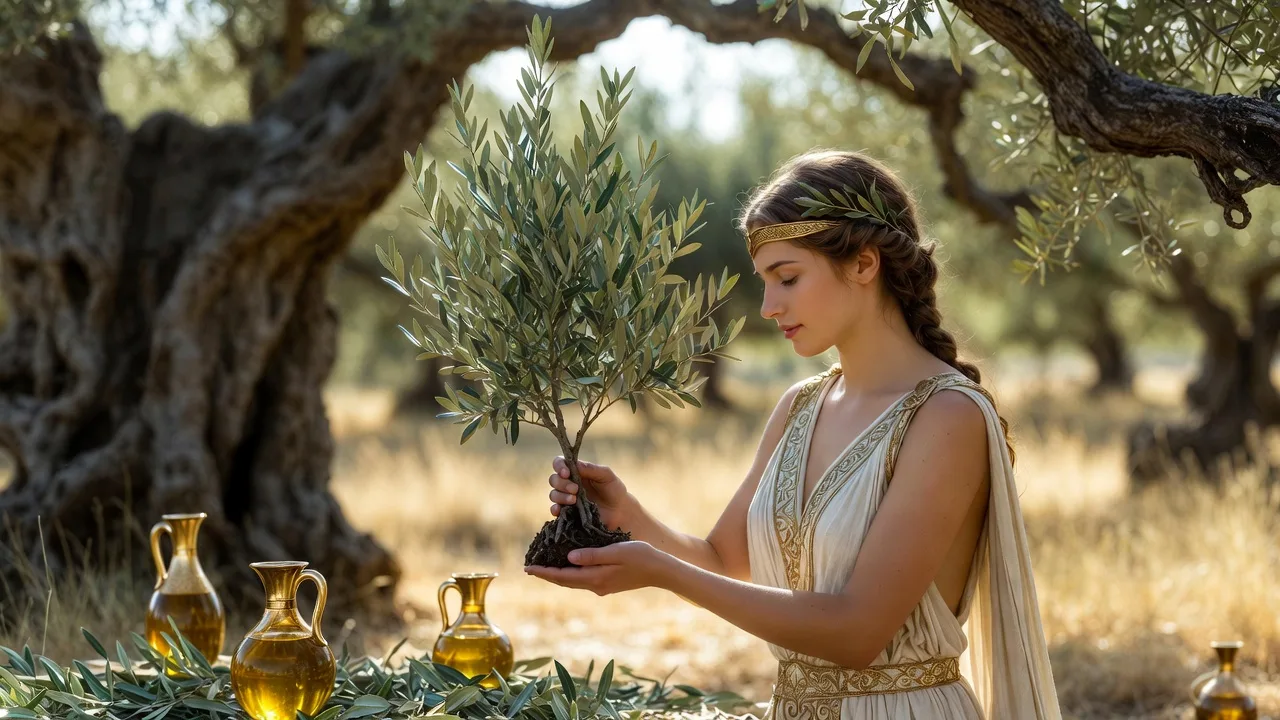
The most famous greek mythology olive oil origin story comes from ancient Athens. According to ancient tradition, the goddess Athena and the god Poseidon competed for the patronage of the newly founded city on the Acropolis. Poseidon struck the rock with his trident, producing a saltwater spring (or, in some versions, a horse). Athena struck the ground with her spear, and an olive tree sprang forth — the first olive tree the world had ever seen.
The citizens, judging Athena's gift more useful than Poseidon's, chose her as their patron. The city was named Athens in her honor. This myth encodes a profound truth: the ancient Greeks valued the olive tree above almost anything else — above horses, above saltwater springs, above the power of the sea god himself. The olive provided food (both as fruit and cooking oil), light (oil lamps), medicine, cleansing agents, athletic ointments, religious offerings, and waterproofing. It was, quite literally, the foundation of civilization.
Ancient Greek Mythology Olive Oil: From Mesopotamia to Greece
First Cultivation: 5,000 BC
Archaeological evidence places the earliest olive cultivation in the Levant (modern-day Israel, Palestine, Lebanon, and Syria) around 5,000-4,000 BC. Clay tablets from the ancient Mesopotamian civilizations of Sumer and Babylon reference olive oil trade. However, it was the Minoans on Crete who first developed large-scale olive oil production around 3,500 BC. The palace of Knossos contained enormous olive oil storage jars (pithoi) holding thousands of liters — olive oil was quite literally a currency of the Minoan economy.
Mycenaean Greece: The First Industrial Producers
The Mycenaean Greeks (1600-1100 BC) elevated olive oil production to an industrial scale. Linear B tablets from Pylos and Mycenae record meticulous inventories of olive oil production, distribution, and trade — indicating a sophisticated, state-controlled industry. Olive oil was used for perfuming and body care, religious rituals, food preparation, lighting, and textile processing. The Mycenaeans exported olive oil across the Mediterranean in distinctive stirrup jars — some of the earliest standardized olive oil containers ever produced.
Classical Greece: The Sacred Economy
In Classical Athens (5th-4th century BC), the olive tree was sacred and legally protected. Cutting down an olive tree was a crime punishable by death or exile. The philosopher Aristotle wrote extensively about olive cultivation, while Hippocrates — the father of medicine — described olive oil as "the great therapeutic" and prescribed it for over 60 different medical conditions. He was, in a sense, the first advocate for daily olive oil consumption.
Greek Mythology Olive Oil and the Ancient Olympics
The connection between olive oil and athletics was deeply embedded in Greek culture. Athletes at the ancient Olympic Games (776 BC - 393 AD) coated their bodies in olive oil before competition — partly for aesthetic reasons (the glistening body was considered beautiful), partly practical (it provided grip resistance and protected against sunburn and wind), and partly spiritual (olive oil was sacred to the gods).
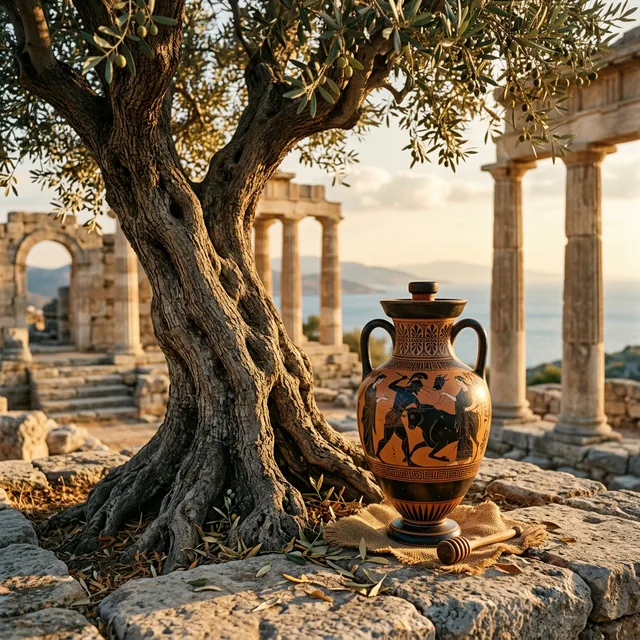
Victory at Olympia was rewarded with a crown (kotinos) woven from the branches of the sacred olive tree at Olympia — said to have been planted by Heracles himself. Victorious athletes were also awarded quantities of olive oil — sometimes hundreds of amphorae, worth enormous sums. The Panathenaic Games in Athens awarded olive oil from the sacred groves of Athena, stored in distinctive black-figure amphora vases that are today among the most prized artifacts in museums worldwide, including the British Museum.
Roman Expansion: Olive Oil Goes Global
The Romans transformed olive oil from a Greek luxury into a Mediterranean staple. Roman engineers developed the screw press — a dramatic improvement over Greek beam presses — increasing extraction efficiency and oil yield. The Roman Empire planted olive groves across its territories: Spain (Hispania), Tunisia (Africa Proconsularis), Libya, southern France (Gaul), and the Dalmatian coast.
Monte Testaccio in Rome — an artificial hill 35 meters high — is made entirely of broken olive oil amphorae (estimated at 53 million vessels). This archaeological marvel testifies to the extraordinary scale of Roman olive oil consumption: the average Roman consumed 20-50 liters per year, using it for cooking, lighting, hygiene, religious ceremonies, and even as a construction material (mixed into concrete). The Romans also established early quality grading systems — distinguishing between first cold pressing "oleum ex albis ulivis" (from green olives) and the lesser grades that followed.
Olive Oil in Religion
Olive Oil in the Bible
The olive tree and its oil appear over 200 times in the Bible, making it one of scripture's most referenced plants. After the Great Flood, it was a dove carrying an olive branch that signaled to Noah that the waters had receded and God's wrath had passed — the olive branch became the universal symbol of peace. In the Old Testament, olive oil was essential for anointing kings (the word "Messiah" in Hebrew and "Christ" in Greek both literally mean "the anointed one" — anointed with olive oil).
The Garden of Gethsemane, where Jesus spent his final night before crucifixion, takes its name from the Hebrew/Aramaic "gat shmanim" — meaning "oil press." Ancient olive trees still grow there today, some estimated at 2,000 years old. Olive oil remains central to Christian sacraments (baptism, confirmation, anointing of the sick), Jewish rituals (Hanukkah commemorates the miraculous olive oil that burned for eight days), and Islamic tradition (the Prophet Muhammad called the olive tree "blessed").
Olive Oil in Islamic Tradition
The Quran references the olive tree directly in Surah An-Nur (24:35), calling it "neither of the East nor of the West" — a blessed tree that provides light-giving oil. The Prophet Muhammad recommended olive oil both as food and medicine, saying "Eat olive oil and anoint yourselves with it, for it comes from a blessed tree." This hadith tradition contributed to extensive olive cultivation across the Islamic world — from Morocco and Tunisia to Turkey, Syria, and Palestine.
Why "Extra Virgin"? The Origin of the Name
The term "virgin" in olive oil has nothing to do with purity in the modern colloquial sense. It derives from the Latin word "virgo" meaning "first" or "initial" — referring to oil from the first pressing of the olives. "Extra virgin" simply means the first pressing produced oil of the highest quality — with no defects and the lowest free fatty acid content. The grading system we use today (extra virgin, virgin, refined, pomace) evolved from Roman-era quality distinctions that have been refined by the International Olive Council over the past century.
How Many Olives to Make Olive Oil?
It takes approximately 5-8 kilograms of olives to produce 1 liter of extra virgin olive oil — depending on the olive variety, ripeness, and growing conditions. Early harvest olives (which produce higher polyphenol oils) yield less — as much as 10-12kg per liter. A single mature olive tree produces 15-40kg of olives per year, meaning one tree yields approximately 2-8 liters of EVOO annually. The labor intensity of olive oil production — especially traditional hand-harvesting in mountainous Mediterranean terrain — explains why quality EVOO costs significantly more than industrially produced seed oils.
Greek Mythology Olive Oil Organic: The Modern Movement
Today's organic olive oil movement draws directly from the greek mythology olive oil organic tradition. Before the 20th century, ALL olive oil was effectively "organic" — grown without synthetic pesticides, herbicides, or fertilizers. The ancient Greeks used natural pest control methods including copper sulfate (still permitted in organic agriculture), companion planting, and natural predator encouragement. The same organic principles celebrated in greek mythology olive oil culture remain the gold standard today.
Modern organic certification (EU Organic, USDA Organic, Australian Organic) requires no synthetic chemical inputs during cultivation, soil conservation practices, biodiversity protection, certified organic processing and storage, and annual third-party audits. The USDA Organic seal guarantees that the olive oil was produced without prohibited substances for at least 3 years prior to harvest.
Organic EVOO typically costs 20-40% more than conventional, but many consumers consider it worthwhile — both for environmental reasons and because organic groves tend to produce oils with higher polyphenol content (reduced chemical stress can increase the tree's natural defense compound production). Some of the highest-polyphenol oils on the market are organic, continuing the greek mythology olive oil organic tradition that stretches back millennia.
Olive Oil Running: Athletic Traditions Revived
The ancient Greek practice of athletes rubbing olive oil on their bodies before competition has found modern echoes. Endurance athletes, particularly marathon runners, use olive oil as a natural anti-chafe agent and skin protectant. Some athletes consume tablespoons of EVOO before races for sustained energy — the high caloric density and slow-burning monounsaturated fats provide steady fuel. Research from PubMed suggests that the polyphenols in EVOO may also reduce exercise-induced oxidative stress and inflammation, supporting faster recovery for health-conscious athletes.
Ancient Olive Oil Containers: From Amphora to Modern Bottles
The evolution of olive oil containers mirrors the evolution of civilization itself. Minoan pithoi (large clay jars) stored thousands of liters in palace cellars. Mycenaean stirrup jars enabled long-distance maritime trade. Roman amphorae — standardized to approximately 70 liters — created the first international commodity transport system. Medieval leather skins and wooden barrels replaced pottery in some regions. Modern dark glass bottles, introduced in the 19th century, finally solved the light-degradation problem that had plagued olive oil storage for millennia.
The Future: Heritage Meets Innovation
Today's olive oil industry stands at the intersection of 5,000 years of greek mythology olive oil organic tradition and cutting-edge extraction technology. DNA analysis is identifying ancient cultivars with exceptional polyphenol profiles. Precision agriculture monitors individual trees with sensors and drones. Climate-controlled storage facilities protect oil quality from harvest to consumer. And nutritional science continues to validate what Hippocrates knew intuitively — that olive oil is indeed "the great therapeutic" for human health.
From Athena's mythical gift on the Acropolis to the sun-drenched groves of the Mediterranean today, the greek mythology olive oil organic heritage remains what it has always been — a symbol of peace, prosperity, wisdom, and the enduring connection between humanity and the land. Every recipe you cook with olive oil, every tablespoon you drink for health, connects you to this 5,000-year story.