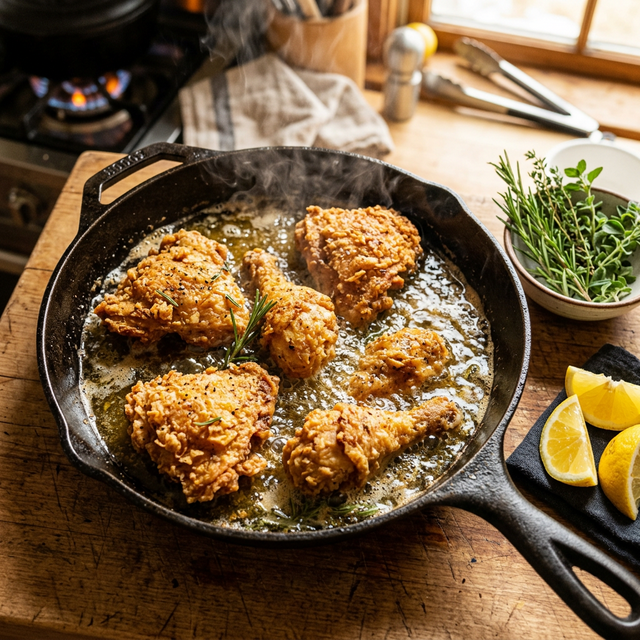
Can you fry chicken in olive oil? Yes — and the results are outstanding. Despite persistent myths that olive oil can't handle frying temperatures, science confirms that extra virgin olive oil is not only safe for frying chicken but actually one of the most stable cooking oils at high heat. The combination of high monounsaturated fat content, natural antioxidants, and a smoke point well above standard frying temperatures makes olive oil an excellent choice for crispy, golden, flavorful fried chicken.
The Smoke Point Myth — Debunked
The biggest objection to frying chicken in olive oil is the smoke point argument. It goes like this: "EVOO has a low smoke point so it breaks down when frying." This is wrong, and research proves it.
Extra virgin olive oil's smoke point ranges from 190-210°C (375-410°F), depending on quality and freshness. The ideal temperature for frying chicken is 160-180°C (325-350°F). That's a comfortable 20-40°C margin below the smoke point — more than enough headroom for safe, stable frying.
A landmark 2018 study published in the journal Acta Scientific Nutritional Health tested 10 common cooking oils at frying temperatures. Extra virgin olive oil produced the lowest levels of harmful polar compounds and trans fats — outperforming canola, sunflower, rice bran, and grape seed oils. The researchers concluded that EVOO is the safest oil for frying, specifically because its polyphenols act as natural antioxidants that resist thermal degradation.
Pan Frying Chicken in Olive Oil: Step by Step
Pan frying is the most practical method for frying chicken in olive oil at home. Here's the technique:
What You Need
- Bone-in chicken pieces (thighs, drumsticks, or breasts) or boneless cutlets
- Extra virgin olive oil — enough to fill your pan 1-2 cm deep (about 350-500ml for a 30cm skillet)
- Flour or seasoned coating of your choice
- A heavy-bottomed skillet or cast iron pan (retains heat evenly)
- Kitchen thermometer (optional but recommended)
The Method
- Bring chicken to room temperature — remove from fridge 20-30 minutes before cooking. Cold chicken drops oil temperature dramatically, resulting in soggy coating
- Season and coat — pat chicken dry, season generously with salt and pepper, dredge in seasoned flour (or your preferred coating)
- Heat the olive oil — pour EVOO into your pan to 1-2 cm depth. Heat over medium-high until it reaches 170°C (340°F). If you don't have a thermometer, drop a small piece of bread or flour into the oil — it should sizzle immediately and brown within 30 seconds
- Fry in batches — don't overcrowd the pan. Place chicken pieces skin-side down, leaving space between each piece. Overcrowding drops the oil temperature and creates steam instead of crisp
- Don't touch it — let the chicken fry undisturbed for 6-8 minutes until the bottom is deep golden brown. Then flip once and fry another 6-8 minutes
- Check doneness — internal temperature should reach 74°C (165°F) at the thickest part. Bone-in pieces may need 12-15 minutes per side
- Rest on a wire rack — not paper towels. A rack lets air circulate, keeping the coating crispy. Paper towels trap steam underneath
Deep Frying Chicken in Olive Oil
Can you deep fry chicken in olive oil? Absolutely. The technique is the same as any deep-fry — submerge chicken fully in oil heated to 170°C. The main consideration is cost: deep frying requires 1-3 liters of oil depending on pot size. At $15-25 per liter for quality EVOO, that's an investment.
The good news: olive oil can be reused for frying 3-4 times when properly strained and stored. After each use, let the oil cool, strain through cheesecloth to remove food particles, and store in a dark container. Discard when the oil darkens significantly, smells off, or smokes at lower temperatures than before.
For deep frying, you can use regular (refined) olive oil instead of extra virgin — it's cheaper, has a slightly higher smoke point (240°C), and the subtle EVOO flavors are less relevant when oil is being reused. The heart-healthy fatty acid profile is identical between refined and extra virgin.
Why Olive Oil Fried Chicken Tastes Better
Fried chicken made with olive oil has a distinctly different flavor profile than chicken fried in vegetable oil or butter:
- Flavor: EVOO adds a subtle fruity, peppery note that enhances the chicken's natural flavor without overpowering it. Particularly noticeable with Arbequina or mild Kalamata oils
- Crispiness: Olive oil produces an exceptionally crispy crust. The high oleic acid content creates a firm, crunchy exterior that stays crispy longer than seed-oil-fried chicken
- Mouthfeel: Less greasy than vegetable oil. Olive oil doesn't leave a heavy, slick coating on the palate — the chicken tastes cleaner
- Color: Beautiful deep golden-brown crust with rich caramelization
Health Benefits of Frying with Olive Oil
Research consistently shows frying with olive oil is healthier than frying with other common cooking oils:
- Less toxic compounds: EVOO produces fewer aldehydes, polar compounds, and oxidation byproducts during frying than seed oils (sunflower, soybean, canola)
- Antioxidant retention: EVOO's polyphenols survive frying temperatures partially, providing antioxidant protection to the food being cooked
- Stable fat profile: Monounsaturated fats (oleic acid) are far more resistant to oxidation than the polyunsaturated fats dominant in vegetable oils
- Mediterranean diet approved: Mediterranean cooking traditionally uses olive oil for all frying — and the Mediterranean diet is consistently ranked the world's healthiest
A 2012 study in the British Medical Journal followed 40,000 Spanish adults and found no association between frying food in olive oil and heart disease risk. The type of oil matters more than the cooking method.
Which Olive Oil Is Best for Frying Chicken?
- For pan frying (best flavor): Use a good quality EVOO like Barbera Frantoia, Coratina, or any cold-pressed EVOO with a mild-medium flavor profile
- For deep frying (best value): Regular (refined) olive oil or a budget EVOO. Don't waste premium single-origin oil on deep frying — the nuanced flavors are masked
- For maximum health: High-polyphenol EVOO — the polyphenols provide extra antioxidant protection during cooking
Common Mistakes When Frying Chicken in Olive Oil
- Oil too cool: Below 160°C, the chicken absorbs oil instead of frying in it. Result: greasy, soggy coating. Use a thermometer
- Oil too hot: Above 200°C, you'll approach the smoke point and risk burning. Medium-high heat, not maximum
- Wet chicken: Moisture causes aggressive spattering and prevents browning. Pat chicken bone-dry before coating
- Overcrowding: Each piece needs space. Fry in 2-3 batches rather than forcing everything in at once
- Moving chicken too early: Let the crust form fully before flipping. If it sticks, it's not ready — wait another minute
- Skipping the rest: Cutting into fried chicken immediately releases steam and makes the coating soggy. Rest 5 minutes minimum
The Verdict
Can you fry chicken in olive oil? Not only can you — you should. Olive oil produces crispier, better-tasting, healthier fried chicken than vegetable oil, canola, or any seed oil alternative. The smoke point myth has been debunked by peer-reviewed research. EVOO is the most stable cooking oil at frying temperatures. Pan fry in quality EVOO for the best flavor, or use regular olive oil for economical deep frying. Either way, your fried chicken will be golden, crispy, and genuinely Mediterranean.