
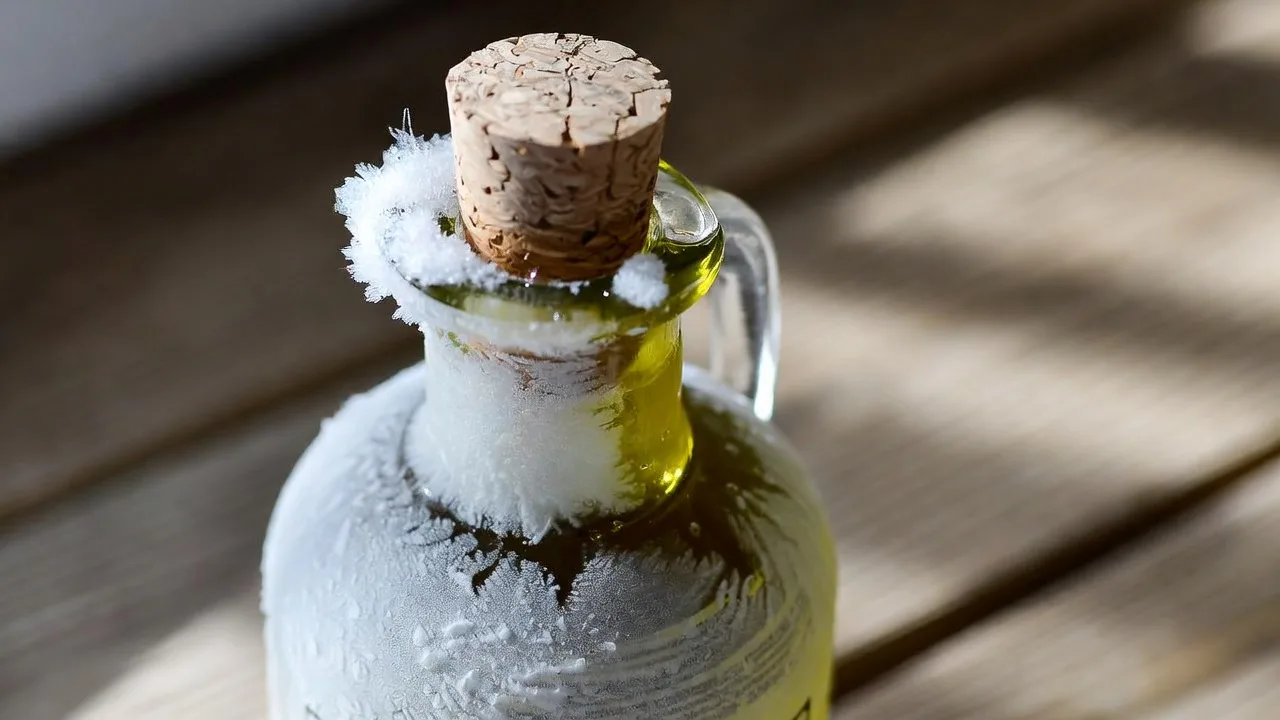
Olive oil can freeze — and it's completely harmless. If you've opened your pantry on a cold morning and found your EVOO cloudy, thick, or fully solidified, nothing is wrong with it. Olive oil can freeze at temperatures below about 4°C (40°F), and it returns to normal liquid form once it warms up. The flavor, nutritional value, and polyphenol content remain intact. But there's a lot of misinformation about what olive oil freezing means for quality, including a widely circulated "fridge test" that claims freezing proves authenticity. This guide separates fact from fiction.
At What Temperature Does Olive Oil Freeze?
Olive oil can freeze, but it doesn't have a single, precise freezing point like water (0°C). Olive oil is a complex mixture of fatty acids, each with a different solidification temperature. This means olive oil freezes gradually across a temperature range rather than all at once.
The typical sequence when olive oil can freeze:
- 10-12°C (50-54°F): The first signs — oil becomes slightly cloudy as saturated fats (palmitic and stearic acid) begin crystallizing
- 4-7°C (39-45°F): Noticeable thickening — the oil becomes viscous, with visible white clumps or waxy streaks forming throughout
- 0-4°C (32-39°F): Partial solidification — most of the oil turns opaque and thick, with a butter-like or lard-like consistency
- Below -12°C (10°F): Full solidification — olive oil can freeze completely solid at deep freezer temperatures
The exact temperature at which olive oil can freeze depends on its fatty acid composition. Oils with more saturated fat (palmitic acid) solidify at higher temperatures. Oils with more monounsaturated fat (oleic acid) stay liquid longer. This is why high-oleic Koroneiki oils from Greece may resist clouding at temperatures where a Moroccan Picholine oil has already turned opaque.
Why Olive Oil Can Freeze: The Chemistry
Understanding why olive oil can freeze requires a quick look at fat chemistry.
Olive oil contains a mix of fatty acids: 70-80% oleic acid (monounsaturated, omega-9), 7-14% linoleic acid (polyunsaturated, omega-6), 0.7-1% alpha-linolenic acid (polyunsaturated, omega-3), and 11-16% saturated fats (palmitic and stearic acid). Each fatty acid type has a different melting point.
Saturated fats have straight molecular chains that pack tightly together — they solidify at relatively high temperatures (palmitic acid melts at 63°C). Monounsaturated fats have a single bend in their chain that prevents tight packing — oleic acid melts at 13°C. Polyunsaturated fats have multiple bends and remain liquid at even lower temperatures.
When olive oil can freeze during cooling, the saturated fats crystallize first (forming the white clumps), followed by the monounsaturated oleic acid. The small percentage of polyunsaturated fats stays liquid longest. This layered solidification is why partially frozen olive oil looks mottled and uneven rather than uniformly solid.
Does Freezing Damage Olive Oil?
No. When olive oil can freeze and then thaws, it returns to its original state with no meaningful quality loss. The International Olive Council confirms that freezing does not alter olive oil's chemical composition, fatty acid profile, or polyphenol content.
What freezing does NOT affect:
- Oleic acid content — unchanged
- Polyphenol levels — preserved (cold actually slows polyphenol degradation)
- Flavor compounds — fully restored when thawed
- Nutritional value — identical before and after freezing
- Smoke point — unaffected
What freezing CAN affect (minimally):
- Appearance: Repeated freeze-thaw cycles can cause permanent slight cloudiness due to micro-crystallization of waxes. This is cosmetic only — the oil is perfectly safe and functional.
- Texture: Some users report a very slight change in mouthfeel after deep freezing — marginally less "silky." Most people can't detect this in blind testing.
Bottom line: if your olive oil can freeze and did freeze — just let it warm up and use it normally.
The Fridge Test Myth: Olive Oil Can Freeze, But That Proves Nothing
A persistent internet myth claims you can test olive oil authenticity by putting it in the fridge. The claim: "real" EVOO will solidify in the fridge, while "fake" oil will stay liquid. This test is scientifically worthless.
The UC Davis Olive Center — the leading olive oil research institution — has explicitly debunked the fridge test. Here's why it fails:
Different varieties freeze differently: A high-oleic Koroneiki EVOO may stay liquid at 4°C, while a high-palmitic Arbequina EVOO solidifies completely. Both are genuine, authentic extra virgin olive oils. The freezing behavior reflects fatty acid composition — not quality or authenticity.
Refined oils can also freeze: Refined olive oil, pomace oil, and even some seed oil blends will solidify in the fridge if they contain enough saturated fat. Solidification proves nothing about whether an oil is extra virgin, refined, or adulterated.
Wax content varies: Some EVOOs are filtered to remove natural waxes; others are bottled unfiltered. Wax content affects solidification temperature but has zero relationship to quality. An unfiltered EVOO will cloud faster than a filtered one — both can be premium products.
The only reliable way to verify olive oil authenticity is laboratory chemical analysis (FFA, peroxide value, UV absorption, sensory panel) or buying from trusted, certified producers. The fridge tells you nothing useful.
How to Thaw Frozen Olive Oil
When olive oil can freeze and you need to use it, thawing is straightforward:
Room temperature (best method): Move the bottle from cold storage to your kitchen counter. At room temperature (20-22°C), fully solidified olive oil returns to liquid in 30-90 minutes depending on volume. This method preserves maximum quality — no risk of heat damage to polyphenols or flavor compounds.
Warm water bath (faster): Place the sealed bottle in a bowl of warm (not hot) water — 35-40°C maximum. The oil thaws in 10-15 minutes. Don't use boiling water or microwaves — extreme heat degrades the cold-pressed quality you paid for.
Direct pour (partial freeze only): If the oil is only partially solidified (thick but still pourable), you can use it directly. Pour what you need and let it come to temperature in the pan or on the food. Partially frozen olive oil works perfectly for cooking — it just takes an extra moment to melt.
Should You Intentionally Freeze Olive Oil?
Some people deliberately freeze olive oil for preservation. This works — with caveats.
Long-term bulk storage: If you buy olive oil in large quantities (5L tins from harvest), freezing unused portions in smaller glass bottles or ice cube trays can extend shelf life significantly. Frozen olive oil can remain high-quality for 12-18 months — much longer than the 6-9 month window for opened oil stored at room temperature. The cold halts oxidation almost completely.
Herb-infused olive oil cubes: Freeze basil infused olive oil or lemon olive oil in ice cube trays for ready-to-use flavor bombs. Pop a frozen olive oil cube into a hot pan and it melts instantly — instant flavor base for pasta, stir-fries, or sautéed vegetables. Each cube is approximately 1 tablespoon.
Portion control: Freezing olive oil in measured portions (ice cube trays, small bottles) makes it easy to track your daily intake — one cube per meal, no pouring or measuring needed.
Cold-Weather Storage Tips
If you live in a cold climate or store olive oil in an unheated space, olive oil can freeze during winter months. Here's how to manage it:
- Keep olive oil indoors: Store in a kitchen cupboard, pantry, or any room maintained above 15°C. Avoid garages, sheds, basements, or storage units that drop below 10°C.
- Shipping precautions: If ordering olive oil online during winter, request insulated packaging. Many premium producers pause shipping during extreme cold to prevent customer confusion when bottles arrive solidified.
- Use dark containers: Proper dark glass or tin containers protect against light damage regardless of temperature. Never store olive oil in clear glass near windows — UV exposure is far more damaging than cold.
- Don't panic: If your olive oil can freeze and did freeze during transit or storage — let it thaw, give it a gentle swirl, and proceed as normal. The oil is fine.
Olive Oil Can Freeze: Quick Reference
- Olive oil can freeze starting around 4-10°C depending on variety and fatty acid composition
- Freezing does NOT damage quality, nutrition, flavor, or polyphenol content
- The "fridge test" for authenticity is a myth — debunked by UC Davis
- Thaw at room temperature (30-90 min) or in a warm water bath (10-15 min)
- Intentional freezing is a valid long-term storage strategy — extends shelf life to 12-18 months
- Frequent freeze-thaw cycles may cause cosmetic cloudiness but no quality loss
- Store above 15°C in dark containers to avoid unintentional freezing
Olive oil can freeze — and that's perfectly okay. Nature designed olive oil to survive Mediterranean winters on the tree. A few hours in a cold pantry won't hurt what 5,000 years of cultivation perfected.